

How Much Is 27 Acres
Contempo swings in woods fiber demand resulting from the COVID-19 pandemic are brilliant examples of the importance of staying upward to date with developing trends in timber markets. For instance, the huge demand shift for tissue products coupled with the slowdown in construction over the last several months presented an ideal fourth dimension to market and sell timber from young pine stands. Likewise, there will besides be good sales opportunities for older pine sawtimber as new home construction gets back on track over the next few months. Based on these tremendous shifts in the market, I wanted to typhoon an update of our nearly popular blog post ever (How Much Money is an Acre of Timber Worth?) to provide some revised trends, context, and related data about the value of pine timber per acre. Since nosotros're talking dollars and cents, it'due south always instructive to stay beside of market place movements during periods of significant turbulence. The original web log mail service analyzed values based on a rolling 12-month fourth dimension frame. This new update will provide more detail by looking at values over a total 3-year menstruation (2017-2019). In keeping with the format of the original mail service, the information below includes pine stumpage [ i] values from timber sales beyond the US South for both natural and plantation stands that were harvested either in thinning (selective tree removal) or clearcut (complete harvest) operations. Before we tin can determine how much an acre of timber is worth, we first need to understand the law of supply and demand ultimately drives the price of timber. Demand is heavily influenced by location, surrounding manufacturing plant types, proximity to those mills, and the volume and type of timber products consumed in a given surface area. The volume and types of products available on a tract of timber volition therefore decide the value per acre. For example, larger pine logs used to industry top-quality grades of lumber are more valuable in a region with multiple sawmills than are smaller logs that are converted to woodchips to brand lurid and paper products. Timberland owners in the US South who manage their land for timber production predominately manage for the growth of large pine logs. These pine timber stands virtually often get through even-aged management regimes where the majority of the trees nowadays are the same age (+/- a couple of years). Even-anile plantation pine stands typically experience ane-ii commercial thinnings and one final commercial harvest, or clearcut. When post-obit this model, thinnings typically remove smaller copse at younger ages and clearcuts remove the rest of the larger trees at older ages. As a result, the size of the trees removed during thinnings and clearcuts are quite unlike and therefore vary in value. In general, pino logs autumn into one of the following categories: For this new analysis, I analyzed US S prices for plantation pine stands on a per-acre basis by harvest type (thinning vs. clearcut) and age class (less than 15 years onetime, 16-20 years one-time, 21-25 years old and 26+ years old). I too analyzed US South prices for natural pine stands by harvest type (curtailed age course data is unavailable for these harvests). With that said, allow's explore the question… Plantation Pine Stands Not surprisingly, start thinnings of young timber brought lower prices from 2017-2019 due to the smaller copse that were removed; just pulpwood and smaller logs that fall into the chip-n-saw category are harvested at this time. However, 2d thinnings in the 21-25 age form typically remove more than but pulpwood, including larger chip-due north-saw logs and smaller-bore sawtimber. Clearcuts, on the other manus, typically deport a college price per acre due to the average size of the trees and the volumes of textile removed. Nearly landowners prefer to clearcut their timberland when it is in the 26+ age class, since a majority of the trees accept reached the higher-value sawtimber category. However, it is important to note a clearcut volition remove all standing timber on a tract of land, which, even in the case of a managed forest in the 26+ age class, will include both pulpwood and scrap-n-saw logs. This mixture of harvested timber products will ultimately affect the price per acre. Some obvious and expected trends can exist detected from the information in a higher place, namely, clearcut harvests of older timber are more valuable per acre. However, in that location are a couple of notable trends as well: Natural Pine Stands Individual age class information is unavailable for natural stands of timber, however, the harvest information of natural pine stands illustrates similar price-per-acre ranges as the plantation pino harvest data. There are a couple of considerations to proceed in mind when analyzing the natural pine data: For a quick comparing of the two, the table below illustrates clearcut values of sawtimber-sized logs from both plantation and natural timber stands over the last iii years. Pine Timber Values/Acre Yr Plantation* Natural 2017 $1,542 $one,618 2018 $1,694 $one,738 2019 $1,566 $2,055 *Boilerplate of all age classes excluding <15 (clearcut) This kind of information can exist very useful in determining emerging market trends, which tin be used to guide operational and strategic planning for both sellers and purchasers of pine timber. For sellers, a trained forester is essential to provide insight into local market dynamics and assist determine an accurate amount of merchantable wood that exists on an acre of timberland. Prices for timber products tin vary considerably even from canton to canton in a specific region based on demand. Equally detailed in the information to a higher place, in that location can be pregnant yearly swings in timber prices based on product type, historic period grade and harvest blazon. Forest2Market's direct market cost information and specific harvest volume information provide the nigh complete and accurate timber pricing service in the southern The states. Our timber toll database is continually updated and contains comprehensive sales data from more than $6 billion in actual timber transactions across the entire region. [i] "Stumpage" is the term used for the purchase price of standing timber and the rights to harvest that timber. In the S, stumpage is almost often quoted in dollars per ton of wood, so we used that measurement to make it at our values.
What Drives Timber Prices?
How Much Money is an Acre of Timber Worth?
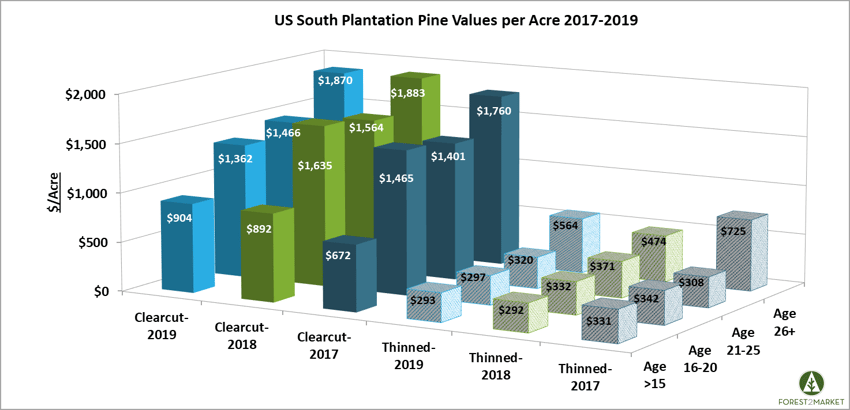

In the nautical chart above, the expected higher stumpage value for clearcut timber sales is evident. Unlike the plantation information, there is a clear trend of increasing stumpage prices over the three-yr period for both clearcut and thinning timber sales on natural stands.
Importance of Current, Reliable Pricing Information

How Much Is 27 Acres,
Source: https://www.forest2market.com/blog/how-much-money-is-an-acre-of-timber-worth
Posted by: wellshentent.blogspot.com
0 Response to "How Much Is 27 Acres"
Post a Comment